Have Working Conditions in the Video Game Industry Improved?
I’m what scientists would refer to as a young whippersnapper. There’s so much about the game industry that I don’t know and am excited to learn. One of the things that I had no idea was a thing until recently was the EA Spouse blog post that cast a prominent light on working conditions in the video game industry (particularly at Electronic Arts). I did some perusing of the many articles written about the subject in addition to the original blog post itself. What’s fascinating is seeing how labor practices in the industry continue to evolve.
I personally don’t feel that there has been any less revelation about the working conditions for game developers in recent years than there was as a result of the EA Spouse blog post. However, I believe the focuses have shifted over time.
Crunch and Working Hours
EA Spouse shed a considerable light on crunch culture in particular. If we look at IGDA survey results for their frequent Developer Satisfaction Survey Summary Reports (I’m focusing on results that exclude freelancers and self-employed individuals.), we can see the percentage of employees over time who report crunch to be a part of their jobs (Chart 1). While there certainly appears to be a steady decrease through the latter half of the 2010s, the numbers have held fairly steady since the new decade and have even risen slightly. Meanwhile, there just isn’t as big of a focus on crunch in the media at the moment. Instead, the focus has been on layoffs and job security, as it should be.
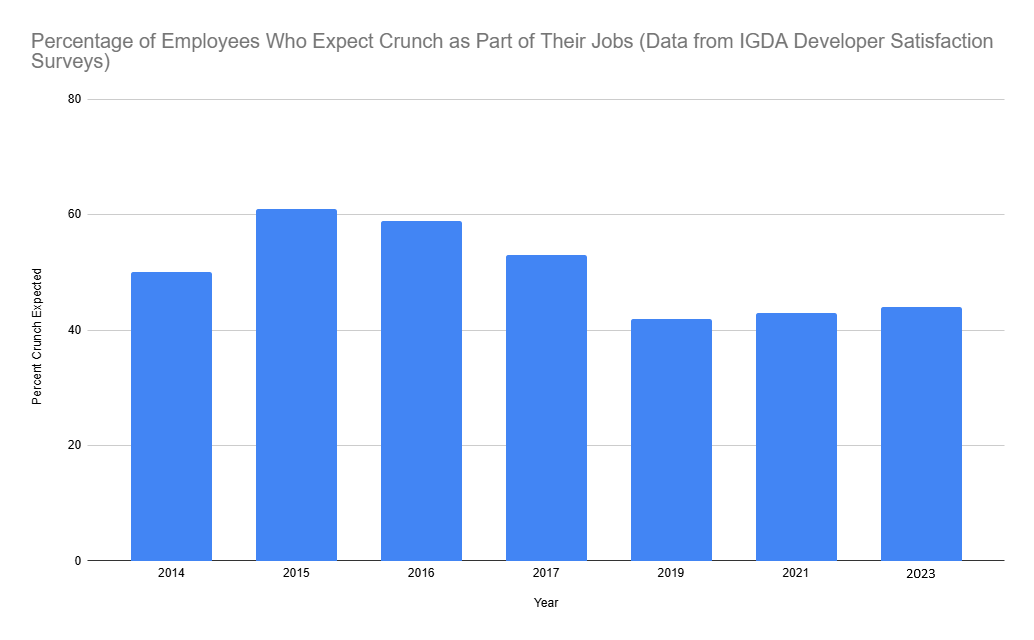
Chart 1
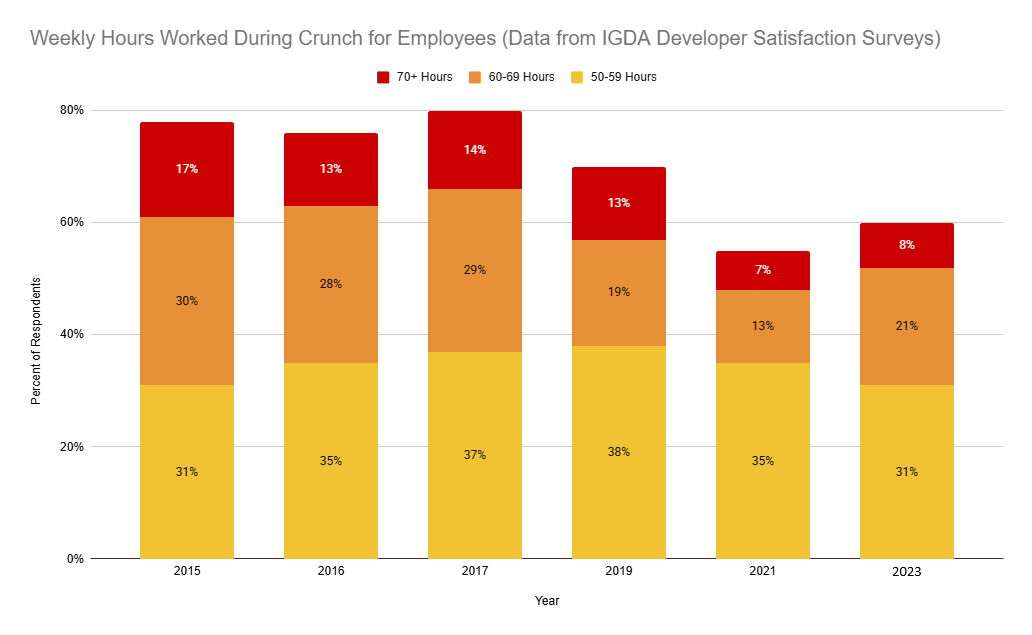
Chart 2
While the percentage of employees who experience crunch appears to not be going down very much, we can look at further data (Chart 2) that suggest while plenty of employees are still experiencing crunch, their hours crunching have gone down significantly over time. A peak of 80% of crunching employees reported 50+ hours per week when crunching in 2017. In the couple of years before 2017, the numbers didn’t look much prettier. However, by the end of the 2010s and heading into 2021, that stat plummeted to 55%. While this is still a lot of workers doing way too many crunch hours, it showed a positive direction. Of course, the X factor is the COVID-19 pandemic. How much did the pandemic affect these numbers, and how much will it continue to do so? After all, with companies instituting back-to-work mandates, we saw a rebound of 50-plus-hour work weeks from 2021 to 2023 with a large increase in the 60-to-69-hour bucket.
However, let’s be honest; the term “crunch” has a bad reputation that isn’t getting any better. Is it possible that while there’s been a bit of a decrease in crunch, companies are simply disguising it as regular working hours? Well, the data doesn’t seem to suggest that.
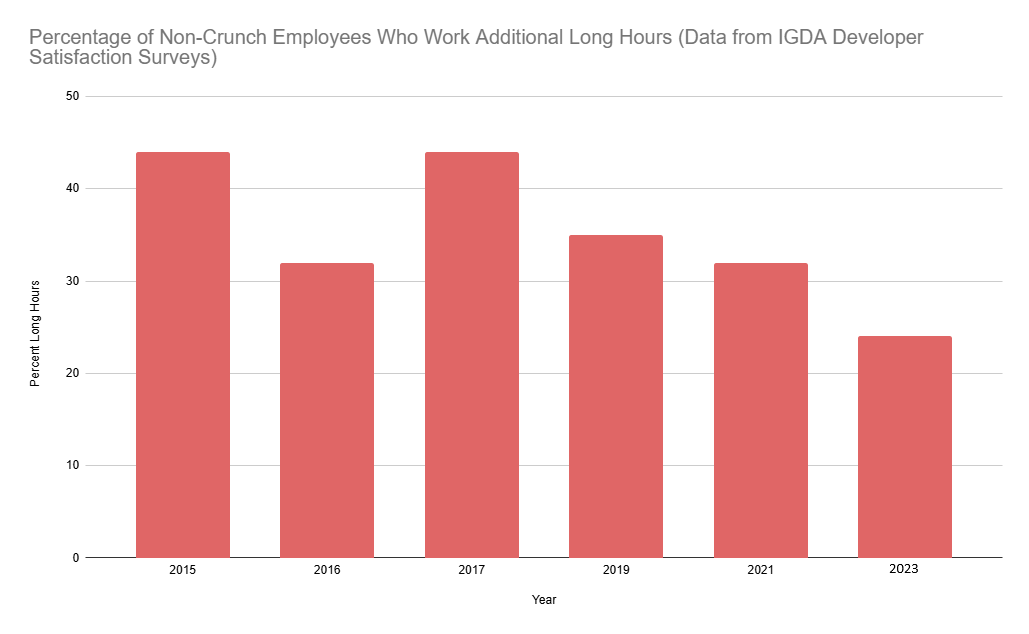
Chart 3
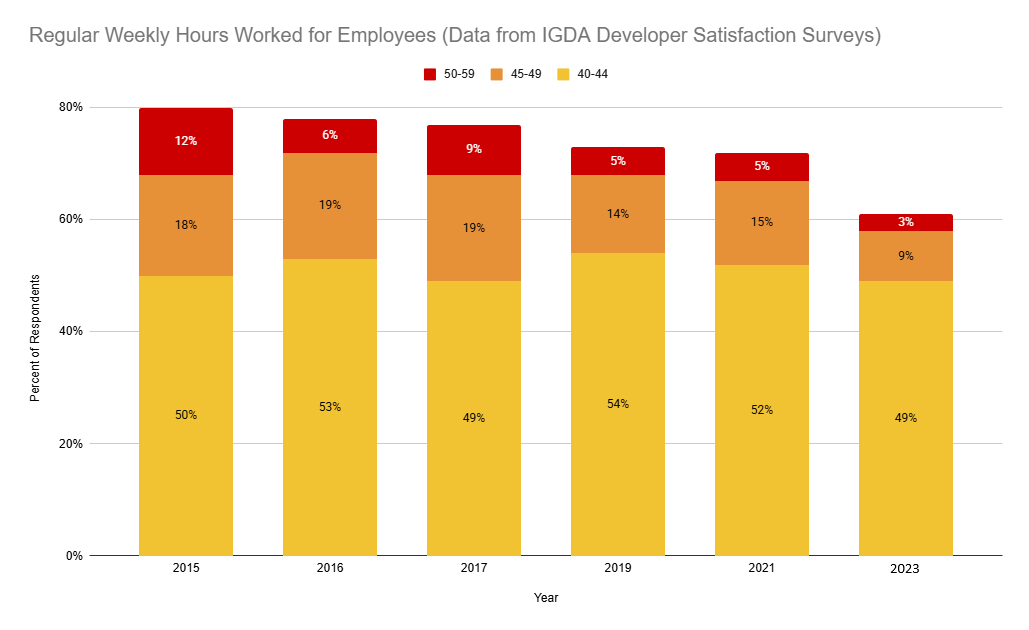
Chart 4 (NOTE: Data from some years included “60+ hours” as a data point. Because it wasn’t consistently reported, and I don’t know the actual reasons for that, I’ve excluded that data, but where it does appear, it’s consistently been around 2% of respondents.)
Charts 3 shows that since 2017, there’s been an overall drastic decline in the number of employees who report long working hours outside of crunch. Furthermore, Chart 4 shows that ever since 2015, survey results consistently show decreases in the number of employees who typically work more than 40 hours per week. What’s better is that of those working more than 40 hours per week, an increasing portion of those don’t exceed 50 hours.
Now, let’s be clear. It’s still horrible to see more than 60% of employed game developers working more than 40 hours per week. It’s also frustrating to see that even after all of the bad press game companies have received for their crunch practices over the past decade, nearly half of all employed game developers still report crunch as simply being part of their jobs. What’s great to see, though, is the trendlines for these practices and where the industry is hopefully headed.
In fact, what I really love about these survey results is what the future of the video games industry can be. From 2015 to 2023, we saw a sharp change in video game labor practices; the number of employees who report crunch as expected at their work dropped 17 points; 18 points for employees crunching 50+ hours per week; non-crunch employees reporting long hours went down 20 points; those regularly working 40-59 hours per week decreased 19 points. And what have been the results of this in the video game industry? The industry continues to break records; games continue to be released; we still have incredible games (just look at 2025’s lineup). The days of executives, managers, and employees saying that grueling hours are just “part of the video game industry” or are even “required” to make games sustainably are coming to an end.
Unfortunately, other aspects of working conditions have seen fewer improvements over the years.
Discrimination
Discrimination has arguably received just as much press as crunch culture this century, but if the IGDA developer satisfaction surveys are to be believed, things aren’t getting any better.
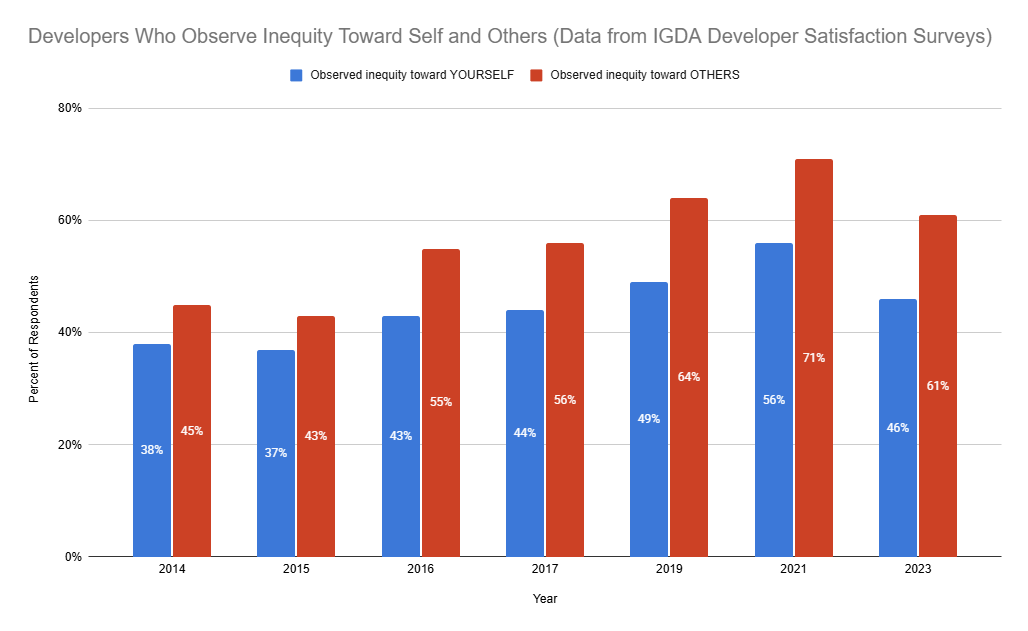
Chart 5
Overall, there was a gradual increase in the number of respondents who reported observing some kind of discrimination/inequity toward themselves or others, followed by a sharp decrease between 2021 and 2023. This shows that despite headlines, discrimination is more prominent than ever.
To better understand these results, it’s important to note that the leading types of discrimination observed across the surveys were consistently Social/Interpersonal and Microaggression. Thus far, this post has largely focused on company policies and managerial decision-making. These most common inequities, on the other hand, can span more than just management, leading to a more encompassing decrease in the quality of working conditions for those who are more likely to experience discrimination based on gender, age, ethnicity, sexual alignment, or ability.
With that said, I have three possible theories as to why we see a steady increase in inequity followed by a sharp dip by the end of 2023:
Work From Home
These higher-inequity categories leave me with some thoughts on what may have happened between 2021 and 2023. There’s a possibility that after the COVID-19 pandemic, as remote jobs continued to become regular parts of the industry, less contact with coworkers led to fewer occurrences of social discrimination and microaggressions.Media Headlines Spur Change
In 2021, media coverage of workplace discrimination in the video game industry was rampant, led by the nauseating reports of abuse and discrimination going on across Activision Blizzard. So over time, we see a steady increase across the industry of these inequities. Eventually, in 2021, it essentially comes to a head and leads to massive headlines for months across multiple large developers. This is then followed by a slight correction that hopefully indicates the new direction the industry is headed.Increased Awareness
Let’s take a moment to recognize that while respondents have largely reported more workplace discrimination than a decade ago, that does not necessarily reflect the actual rates of discriminatory acts in the workplace. These trends could be highlighting an increase of awareness of discrimination rather than an actual increase in inequity over time.
Perhaps in 2014, the average developer simply had a different breadth of knowledge regarding what is and is not discrimination than they do today. It could be that Chart 5 shows an industry recognizing the problem over time as opposed to the problem itself getting worse. Essentially, my hypothesis is that from 2014 through 2021, there was a lot of education in the workplace and the media regarding discrimination in the video game industry. Then, the dip in 2023 reflects workplace discrimination changing at a higher rate than awareness spreading.
In actuality, it’s probably a combination of these along with some other stuff that I didn’t think of. Of course, this is all my speculation. I’m not nearly enough of an expert in workplace discrimination or human resources to truly start analyzing cause and effect. These should be taken as the musings of a curious game developer.
Regardless, you don’t have to have any qualifications to be anxious for the next developer satisfaction survey. I definitely want to see if these numbers continue in their new downward trend.
Job Security
This is where the dataset I’ve been using from the IGDA is going to fail us. Without any data past 2023, we’re not telling a very realistic story of job security in today’s video game industry. While the lack of job security for developers populates a lot of headlines today, the problem has existed at least dating back to the turn of the century. I have a lot of opinions about why layoffs occur, but at the end of the day, “permanent” employees shouldn’t sign their contracts with the expectation that they will leave the company within the following couple of years. According to the IGDA surveys, consistently from 2016 through 2023, between 50% and 60% of employees don’t expect to remain at their employer for more than three years. When companies treat employees right and managers/executives do their jobs effectively, developers should feel empowered to stay at their jobs for far longer than this and capable of doing so.
And longer employment doesn’t just improve the lives of employees. Based on typical timelines for game development, these statistics amount to a majority of the industry only expecting to release one game before moving on to another job. In an industry like video games, this loss of institutional knowledge and costs of recruiting, hiring, and training new employees from game to game can spell disaster for most companies.
Again, these numbers come from before layoffs truly came to a head following the COVID-19 pandemic. According to the Game Developers Conference 2026 State of the Game Industry Report, in 2024 and 2025, an estimated 33% of video game employees had experienced layoffs. The layoff probabilities at AAA studios are even more frightening. Two-thirds of AAA studio employees reported that their company experienced layoffs. What sort of backwards industry do we inhabit where AAA studios with supposedly the most reliable games, the most capital, the most revenue, the most profit, and the highest-paid executives experience the most layoffs?
Industry rallying cries will continue to include complaints about job security until we see change.
Overall, I would say that yes, I see improvements over time for working conditions in the video game industry. However, it’s still a young industry. As it continues to mature, I expect to see more consistent standards introduced and pushed hard by the growing population of video game unions across the globe.